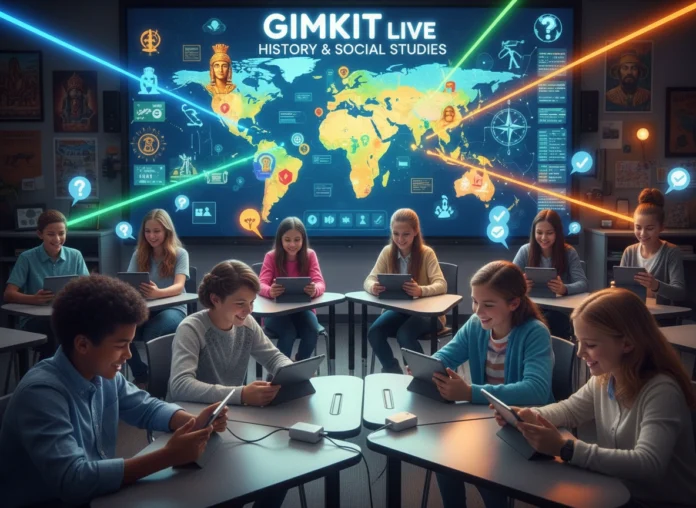
History and social studies classrooms are treasure troves of stories, pivotal moments, and complex ideas that have shaped our world. Yet, educators often face the challenge of bringing these subjects to life for students accustomed to a fast-paced, digital environment. Traditional methods like lectures and textbook readings can sometimes fall short of capturing their full attention. This is where modern educational technology can bridge the gap, transforming passive learning into an active, engaging experience. Gimkit, a dynamic and interactive learning platform, is one such tool that is revolutionizing how history and social studies are taught.
Gimkit merges the structure of a classroom quiz with the excitement of a live-action game. It moves beyond simple question-and-answer formats by incorporating strategy, collaboration, and competition. Students don’t just answer questions; they earn in-game currency, purchase power-ups, and work towards a collective or individual goal. This gamified approach taps into students’ natural desire for play and competition, making the process of learning historical facts, geographical locations, and civic concepts feel less like a chore and more like an adventure.
Transforming Traditional Topics with Gamified Learning
The true power of Gimkit in a history or social studies context lies in its versatility. It can be adapted to almost any topic, from ancient civilizations to modern political science, turning what could be dry material into a memorable activity.
Interactive Quizzes on Historical Events: Imagine teaching the American Revolution. Instead of a standard multiple-choice worksheet, you can create a Gimkit game. Questions could cover key figures like George Washington and Thomas Jefferson, significant battles such as Saratoga and Yorktown, and the timeline of events leading to the Declaration of Independence. As students answer correctly, they earn virtual money. They can then use this to buy upgrades, like earning more money per question or getting a second chance on an incorrect answer. This layer of strategy keeps them invested and encourages them to recall information quickly and accurately. The competitive nature of the game motivates students to master the material to outperform their peers or reach a class goal.
Building Understanding of Complex Timelines: History is often a story of cause and effect, with events unfolding over long periods. Understanding chronology is fundamental. Gimkit can be used to create interactive timelines. A teacher could set up a “Kit” (Gimkit’s term for a quiz set) where students must place events in the correct order. For a unit on World War II, questions might ask students to identify which event came first: the invasion of Poland or the attack on Pearl Harbor. The immediate feedback loop helps correct misunderstandings instantly. By playing the game multiple times, students reinforce their knowledge of the sequence of events, building a stronger mental framework of the historical narrative.
Gamified Assessments and Formative Feedback: One of the most significant benefits of Gimkit is its capacity for formative assessment. Teachers can use it as a low-stakes way to check for understanding throughout a unit. A quick 10-minute game at the end of a lesson on the Roman Empire can provide immediate insight into which concepts students have grasped and which require further review. The platform generates detailed reports after each game, showing individual and class-wide performance. This data is invaluable for educators. It allows them to see which questions were most frequently missed, highlighting areas where the class may be struggling. This real-time feedback loop enables teachers to adjust their lesson plans on the fly, providing targeted support where it’s needed most.
The Clear Advantages of Integrating Gimkit
Incorporating Gimkit into the history and social studies curriculum offers a host of benefits that extend beyond simple fun. These advantages contribute to a more effective and inclusive learning environment.
Increased Student Participation and Engagement: The most immediate effect of using Gimkit is a noticeable spike in student engagement. The fast-paced, game-like atmosphere captures the attention of even the most reluctant learners. The element of competition, whether played individually or in teams, encourages active participation from everyone. Students who might hesitate to raise their hand in a traditional classroom setting often feel more comfortable participating in a digital game. This active involvement helps solidify their understanding and retention of the material.
Catering to Diverse Learning Styles: Every classroom is filled with students who learn in different ways. Gimkit’s multi-modal approach appeals to a wide range of learning styles. Visual learners benefit from the on-screen text and graphics. Kinesthetic learners are engaged by the interactive nature of answering questions and making strategic choices. The competitive aspect can be highly motivating for some, while the collaborative team modes appeal to students who thrive on social interaction. This flexibility ensures that more students have an opportunity to connect with the content in a way that works for them.
Reinforcing Knowledge Through Repetition: Mastery in any subject often comes down to repetition. Gimkit makes this process enjoyable. In many of its game modes, students will see the same questions multiple times, especially those they answered incorrectly. This spaced repetition is a proven method for moving information from short-term to long-term memory. Instead of drilling flashcards, students are reinforcing their knowledge in an exciting and dynamic context, which dramatically improves information retention.
Practical Tips for Effective Integration
To make the most of Gimkit, it’s important to integrate it thoughtfully into your curriculum. It should serve as a tool to enhance your teaching, not simply replace it.
- Start with a Clear Learning Objective: Before creating a Kit, define what you want your students to learn. Are you reviewing key vocabulary for a unit on the Cold War? Are you checking their understanding of the three branches of government? A clear objective will help you craft focused and effective questions.
- Use It for Both Review and Introduction: Gimkit is excellent for reviewing material before a test, but it can also be used to introduce a new topic. Create a Kit with questions you expect students may not know the answers to. This can pique their curiosity and give them a preview of the concepts you will be covering.
- Explore Different Game Modes: Don’t stick to just one game mode. Gimkit offers various options, including team-based games like “Humans vs. Zombies” and strategic modes like “The Floor is Lava.” Different modes emphasize different skills—some focus on speed, others on accuracy, and some on collaboration. Varying the game mode keeps the experience fresh and engaging for students.
- Leverage Post-Game Reports: After each game, take a few minutes to review the report with your class. Celebrate the top performers, but more importantly, discuss the questions that a large percentage of the class missed. This turns the game into a powerful learning moment, allowing you to address common misconceptions in real time.
- Empower Students to Create: Turn the tables and have students create their own Kits. Assign individuals or groups a specific topic from your unit, like a particular battle, historical figure, or legal concept. This requires them to research, identify key information, and formulate clear questions. Presenting their Kit to the class deepens their own understanding and provides a valuable review for their peers.
History and social studies are fundamentally about the human experience. By making learning interactive, we help students connect with the material on a deeper level. Tools like Gimkit provide a powerful way to foster that connection, transforming the classroom into an exciting arena of discovery. When students are engaged, motivated, and having fun, they are not just memorizing dates and names—they are actively participating in the story of our world.
Please visit this website for more info.

