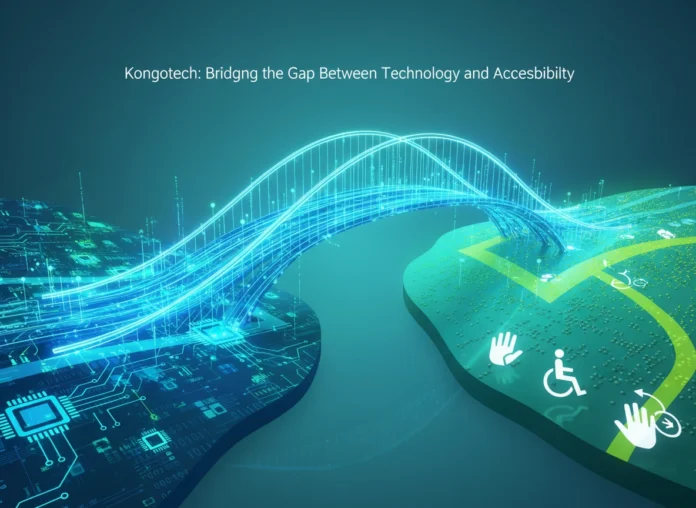
Technology holds the promise of empowering everyone, yet for millions of people worldwide, the digital revolution has often felt out of reach. Standard interfaces, expensive hardware, and design oversights frequently exclude individuals with disabilities and those in underserved communities. This is the precise gap that Kongotech aims to close. By prioritizing inclusive design and affordable innovation, Kongotech is not just building gadgets; they are building bridges.
This article explores how Kongotech is redefining the landscape of accessible technology. We will delve into their core philosophy, examine their groundbreaking products, and analyze the real-world impact they are having on users who have long been sidelined by the mainstream tech industry.
The Accessibility Crisis in Modern Tech
Before understanding Kongotech’s solution, we must first understand the problem. The World Health Organization estimates that over 1 billion people live with some form of disability. That represents about 15% of the global population. Despite this massive demographic, digital accessibility often remains an afterthought.
Websites are frequently incompatible with screen readers. Voice assistants struggle with non-standard speech patterns. Smart home devices often require fine motor skills that not everyone possesses. This creates a “digital divide” where technology, rather than being an equalizer, becomes a barrier to education, employment, and social connection.
This divide is where Kongotech operates. Founded on the principle that access to technology is a human right, the company has dedicated its R&D efforts to solving these specific friction points.
Kongotech’s Core Philosophy: Inclusive by Design
Unlike many competitors who retrofit accessibility features onto existing products, Kongotech builds with inclusivity as the foundation. Their “Inclusive by Design” philosophy means that people with disabilities are involved at every stage of the product development lifecycle—from ideation to beta testing.
User-Centric Development
Kongotech employs a diverse team of engineers and designers, many of whom live with disabilities themselves. This internal diversity ensures that the solutions they create are practical rather than theoretical. For example, a developer who is visually impaired will have a much deeper understanding of navigation pain points than a sighted developer relying solely on guidelines.
Affordability as Accessibility
Accessibility isn’t just about physical capability; it’s also about economic capability. Assistive technology has historically been prohibitively expensive. A specialized braille display can cost thousands of dollars. Kongotech disrupts this market by using scalable, open-source software and modular hardware components to keep costs low, ensuring their innovations reach underserved communities in developing nations as well as established markets.
Innovations Driving Change
Kongotech’s product portfolio is diverse, targeting specific needs across vision, hearing, motor, and cognitive impairments. Here are three key initiatives that illustrate their impact.
1. The KongoVoice Interface
Standard voice assistants like Siri or Alexa are marvels of engineering, but they often fail users with speech impediments or non-standard dialects. The KongoVoice Interface uses a proprietary AI engine trained on a massive dataset of atypical speech patterns.
This system learns the specific nuances of a user’s voice over time. For a user with cerebral palsy whose speech might be difficult for a standard AI to parse, KongoVoice adapts, learning to recognize unique phonemes and cadences. This allows users to control smart home environments, dictate emails, and navigate the web with a level of independence previously unavailable to them.
2. The HapticSense Wearable Suite
For individuals with hearing impairments, navigating a world built on auditory cues can be dangerous and isolating. Kongotech’s HapticSense line consists of discreet wearables—wristbands and smart clothing—that translate sound into vibration.
Unlike simple vibrating alerts, HapticSense provides nuanced feedback. A door knock feels different from a crying baby, which feels different from a fire alarm. The device uses a sophisticated algorithm to analyze environmental audio and convert it into a distinct “haptic language.” Users report feeling safer in their homes and more connected to their surroundings.
3. Project Modular: Adaptive Input Devices
Traditional keyboards and mice require a specific range of motion and dexterity. Project Modular is Kongotech’s answer to rigid hardware design. It is a system of interlocking, customizable input modules.
Users can snap together large buttons, joysticks, trackballs, and sip-and-puff switches in whatever configuration suits their physical abilities. The accompanying software instantly recognizes the layout and maps it to standard computer functions. This plug-and-play approach removes the need for expensive, custom-built controllers, making gaming and computer use accessible to people with limited mobility.
Real-World Impact: Stories from the Community
The true measure of technology is how it changes lives. Kongotech’s initiatives have already produced tangible results for users globally.
Consider the case of Elena, a graphic designer who developed severe rheumatoid arthritis. The pain in her hands made using a standard mouse impossible, threatening her career. Using Kongotech’s Project Modular, she constructed a custom interface that relies on forearm movements and foot pedals. “I thought my career was over,” she says. “Kongotech didn’t just give me a tool; they gave me my livelihood back.”
In an educational pilot program in Kenya, Kongotech deployed low-cost tablets equipped with offline-capable screen readers for visually impaired students. Prior to this, these students relied on scarce braille textbooks. With the new tablets, they gained access to thousands of digital books, leveling the academic playing field and opening doors to higher education.
Challenges in the Accessibility Landscape
Despite these successes, Kongotech faces significant hurdles. The path to universal accessibility is not without resistance.
The Interoperability Hurdle
One of the biggest technical challenges is ensuring Kongotech devices work seamlessly with the broader tech ecosystem. If a major operating system update changes how external input devices are handled, it can break compatibility with assistive tech overnight. Kongotech invests heavily in maintaining partnerships with major tech giants to ensure their devices remain compatible, but the reliance on third-party platforms remains a vulnerability.
The Stigma of “Assistive” Tech
Historically, assistive devices have looked medical and clinical. Kongotech fights hard to make their products aesthetically pleasing—sleek, modern, and desirable. Overcoming the stigma that accessible tech is “uncool” or strictly medical requires a shift in marketing and design language, something Kongotech is actively pursuing.
Scaling Personalized Solutions
Customization is key to accessibility, but it is the enemy of mass production. Scaling a product like Project Modular, which relies on varied components, is logistically complex compared to shipping a standard keyboard. Kongotech is tackling this through advanced 3D printing techniques and localized manufacturing hubs, but balancing personalization with scale remains a constant operational challenge.
The Future of Kongotech
Looking ahead, Kongotech is not resting on its laurels. The company views AI and augmented reality (AR) as the next frontiers for accessibility.
They are currently beta-testing KongoVision, an AR headset designed to assist users with low vision. By using edge detection and high-contrast overlays in real-time, the headset highlights obstacles, reads signs, and identifies faces, projecting enhanced visuals directly onto the user’s retina.
Furthermore, Kongotech plans to open-source more of its software stack. They believe that accessibility should not be a walled garden. by allowing developers worldwide to contribute to their code, they hope to accelerate the pace of innovation and encourage other companies to adopt their standards.
Conclusion
Kongotech demonstrates that technology does not have to be exclusive to be profitable or innovative. By centering the needs of people with disabilities, they are creating better products for everyone. Features like voice control and haptic feedback, once considered niche accessibility tools, are now mainstream conveniences.
The gap between technology and accessibility is narrowing, but it hasn’t closed yet. Through initiatives like KongoVoice and Project Modular, Kongotech is doing the heavy lifting to build that bridge. As we move into an increasingly digital future, their work ensures that this future belongs to all of us, regardless of physical ability.
For businesses and developers, the lesson from Kongotech is clear: Inclusivity isn’t a charity; it’s an innovation strategy. When we design for the margins, we create a stronger, more resilient center.
Please vist this website for more info.

