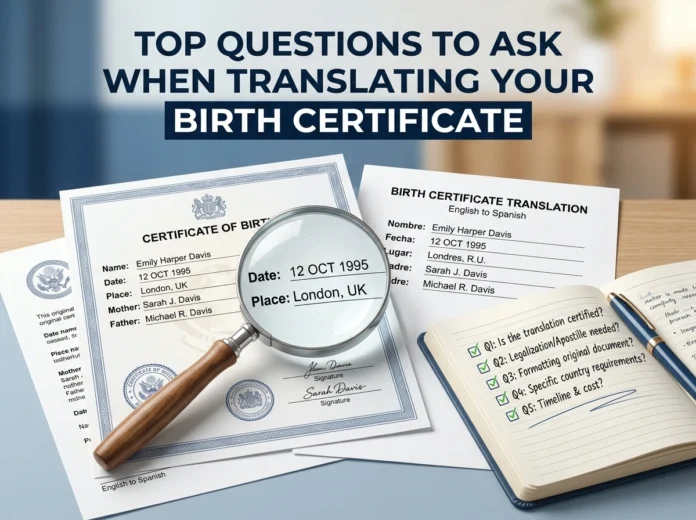
Navigating the complexities of immigration, university admissions, or legal proceedings often requires a mountain of paperwork. Among the most critical documents you will need to provide is your birth certificate. If your original document is in a language other than English, you must obtain a professional translation to ensure it is accepted by official institutions in the United States. Finding a reliable service provider can feel overwhelming, especially when the success of your application depends entirely on the accuracy and validity of this single document.
Many people begin their search by looking for local options, hoping a nearby office will provide peace of mind and quick results. However, proximity does not always guarantee quality, compliance, or affordability. Choosing the wrong provider can lead to rejected applications, missed deadlines, and lost money. Before you hand over such a sensitive and vital document to a local agency, you need to know exactly how to evaluate their services, standards, and pricing structures.
To protect your personal information and ensure your documents meet all official requirements, asking the right questions upfront is essential. This comprehensive guide will walk you through the most important questions to ask when you are searching for birth certificate translation near me. By keeping these considerations in mind, you can confidently select a translation service that offers precision, compliance, and total peace of mind.
Is the translation certified and USCIS-accepted?
The single most important factor when translating official documents for immigration or legal purposes is certification. United States Citizenship and Immigration Services (USCIS) has strict requirements regarding how foreign language documents must be presented. A standard, informal translation will be immediately rejected, which can delay your visa or citizenship application by months.
When interviewing a potential local service, you must ask if they provide a formal “certificate of accuracy.” This certification is a signed statement from the translator or the translation agency affirming that the translated text is an exact and accurate rendering of the original document. The statement must also confirm that the translator is competent to translate from the source language into English.
Some local agencies might offer general translation services for business or marketing materials but lack the specific formatting and certification protocols required by government bodies. Always verify their success rate with USCIS submissions. A reputable translation provider will clearly state that their certified translations are universally accepted by USCIS, federal and state courts, and academic institutions.
What is the typical turnaround time for local services?
Timing is frequently a critical factor when dealing with official applications. You might have a strict deadline to submit evidence to a court, or you may be rushing to meet a university enrollment cutoff. When inquiring about translation services, you need a precise estimate of their turnaround time for a standard birth certificate.
Many traditional brick-and-mortar translation offices operate on standard business hours and may have a backlog of projects. This can result in waiting periods of a week or more for a single-page document. Ask the provider what their baseline processing time is for documents under 250 words. Ideally, a standard turnaround should be around 24 to 48 hours.
You should also inquire about expedited services. If you face an unexpected deadline, you need to know if the provider can deliver the translation in 12 hours or less. Clarify exactly how expedited processing affects the final price. Some agencies will double the total cost for a rush job, while others charge a flat fee per page for accelerated delivery.
How do you ensure the security and confidentiality of my documents?
A birth certificate contains some of your most sensitive personally identifiable information, including your full legal name, date of birth, place of birth, and your parents’ full names. Handing this information over to an unverified third party poses significant identity theft and privacy risks. Document security must be a top priority during your selection process.
Ask the provider about their data handling protocols. If you are submitting your document digitally, ensure their website uses secure, encrypted connections. If you are dropping off a physical copy at a local office, ask who will have access to the document and how it is stored while in their possession.
Professional translation agencies will require all their translators and staff members to sign strict non-disclosure agreements (NDAs) and confidentiality policies. Furthermore, they should have a clear data retention policy. Find out how long they keep digital copies of your translation on their servers and whether you can request the immediate deletion of your files once the project is successfully completed.
What are the qualifications of your translators?
Accuracy is non-negotiable when translating a birth certificate. Even a minor error, such as a misspelled name or an incorrect date format, can cause government agencies to question the document’s authenticity and reject your application. Therefore, understanding the qualifications of the individuals performing the work is absolutely necessary.
Inquire if the agency uses native speakers of the target language who are completely fluent in the source language. Furthermore, professional credentials add a significant layer of reliability. Ask if their translators are members of recognized industry organizations, such as the American Translators Association (ATA). Membership in such organizations indicates a commitment to professional standards and ongoing education.
Additionally, you want to ensure the work is performed by human experts rather than purely automated software. While machine translation has advanced, official documents require a human eye to accurately translate cultural nuances, specific legal terminologies, and complex formatting, such as regional seals and stamps.
Are there hidden fees or extra costs for certification?
Pricing transparency varies wildly across the translation industry. What appears to be a cheap local service can quickly become expensive once hidden fees are applied. Before agreeing to a service, you must ask for a complete, itemized breakdown of the costs.
Start by asking how they calculate their base rate. Is it priced per word, per hour, or per page? For official documents like birth certificates, a flat per-page rate (often defined as up to 250 words) is the most straightforward and predictable pricing model. Standard rates often hover around $29.95 per page.
Next, inquire about the “extras.” Some local agencies advertise a low translation rate but charge heavily for the certificate of accuracy itself. Others might charge extra for handling handwritten text, which is common on older birth certificates. You should also ask about the costs associated with notarization or obtaining an Apostille, as these are frequently required for documents being sent abroad or used in specific legal contexts. Knowing these potential charges upfront prevents unpleasant surprises when you receive the final invoice.
Do you provide a digital copy as well as a physical copy?
The format in which you receive your translated birth certificate dictates how easily you can use it. Today, many government systems, including USCIS, encourage or mandate online filing for various applications. For these purposes, a high-quality, certified digital copy (usually a secure PDF) is essential.
However, certain situations still require physical documents with wet-ink signatures and raised notary seals. For example, applying for a U.S. passport at a post office or presenting evidence in a physical courtroom usually requires hard copies. Ask the local provider if their standard fee includes both a secure digital download and the mailing of physical copies.
If they do mail physical copies, ask about their shipping methods and costs. Find out if they offer free standard shipping or if you must pay extra for tracked, expedited mailing services like FedEx or UPS Priority. A service that offers flexible delivery options ensures you have the exact format you need, precisely when you need it.
How does the local search compare to online specialized services?
While looking for a business in your immediate geographic area feels reassuring, you should actively compare local offerings with specialized online translation agencies. When you ask a local provider about their services, weigh their answers against what national, online companies provide.
Online translation services frequently maintain large networks of thousands of professional translators across over 100 languages. Because of this vast network, they can operate around the clock, offering faster turnaround times than a local office that closes at 5:00 PM. An online agency can often process a birth certificate translation in 24 hours without exorbitant rush fees.
Furthermore, specialized online agencies process hundreds of USCIS-bound documents daily. They are intimately familiar with the exact formatting, phrasing, and certification requirements demanded by federal authorities. While a local generalist might translate a birth certificate occasionally, a specialized online service does it constantly, significantly reducing the risk of formatting errors or certification rejections.
Frequently Asked Questions About Birth Certificate Translation
To help you further understand the process, here are a few common questions individuals have when preparing their official documents.
Do I need my translation notarized?
Notarization and certification are two different things. A certified translation includes a signed statement of accuracy. A notarized translation means a Notary Public has verified the identity of the person signing that statement of accuracy. USCIS generally does not require notarization for translations. However, local courts, universities, or foreign embassies often do. Always check the specific requirements of the institution receiving your document.
What is an Apostille, and do I need one?
An Apostille is a specialized certificate that authenticates the origin of a public document for use in another country that is part of the Hague Convention. If you are submitting your translated U.S. birth certificate to a foreign government (for dual citizenship, marriage abroad, etc.), you will likely need an Apostille. Translation agencies can often facilitate this process for an additional fee.
What if my birth certificate has messy handwriting?
Older birth certificates or those from specific regions frequently feature cursive handwriting. Translators must decipher this text accurately. When requesting a quote, you should upload the document so the agency can evaluate the legibility. Be aware that documents with complex, hard-to-read handwriting may incur a small surcharge due to the extra time required for transcription.
Final Checklist for Choosing a Translation Provider
Selecting the right service to translate your vital records does not have to be stressful. By asking the questions outlined above, you take control of the process and ensure your personal information is handled with the utmost professionalism.
As you finalize your decision, review this brief checklist:
- Confirm the translation includes a formal certificate of accuracy.
- Verify the agency guarantees acceptance by USCIS and other relevant institutions.
- Ensure the pricing structure is entirely transparent, with no hidden fees for certification or standard digital delivery.
- Check that the provider employs strict data security and confidentiality measures.
- Confirm the turnaround time aligns perfectly with your application deadlines.
By diligently vetting your options, you safeguard your application process. Accurate, certified document translation paves the way for smooth processing, allowing you to move forward with your educational, legal, or immigration goals without unnecessary delays.

